Is Your Worship Just a Song, or Is It Your Whole Life?
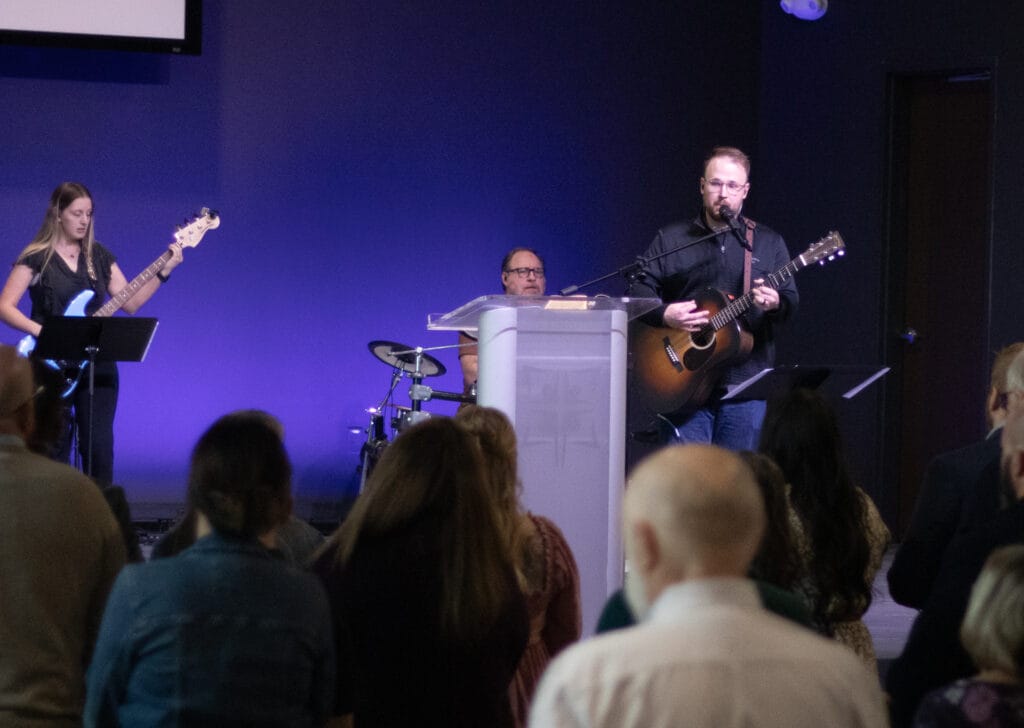
What if the greatest instrument in a church isn’t the one made of wood and metal up front, but the hearts and voices of the people sitting in the pews? What if worship isn’t really about whether you know all the words to a song, but about who God is and how you respond to Him? Those were the questions I sat with this week as I prepared to close out our two-week look at the core principles here at Community Baptist Church. Last week I laid out the first five: a proper view of God, Christ-centered ministry, being Bible-based, being prayerful, and biblical leadership. This week, we finish the list, and it starts with worship.
I opened in Acts 2, the same passage from last Sunday, where the early church devoted themselves to the apostles’ teaching, the fellowship, the breaking of bread, and the prayers. That’s the picture I keep coming back to as I share these principles with you, not because we’ve arrived, but because these are our goals. As I told the church, “worship is fundamentally about revelation and response.”
Our Worship Must Be Biblical
So often we go through the motions, whether it’s prayer or singing, and we lose sight of what worship actually is. I said it plainly: “so often we go through the motions, whether it’s our prayer time, whether it’s our singing, and we just kind of just go through the motions, but really my excitement is who is God? How has God revealed Himself in the Scriptures? And what’s an appropriate response to us?”
Our singing has to be biblical in content, drawing from Colossians 3:16 and Ephesians 5:18, letting the word of Christ dwell in us richly so that psalms, hymns, and spiritual songs flow out of a heart that has already responded to truth. But I want to push past the idea that worship is just what happens in the singing portion of our service. Romans 12:1 tells us to present our bodies as a living sacrifice, that’s our reasonable service. I asked the room, “Is your life given to Christ? Is your life given over to the gospel and what he has called you to do?” I told the story of a family who used to pray over their tithe check every single week before writing it, because they understood their giving was worship too.
As for how we express that worship, whether it’s raised hands, clapping, quietness, or even the dancing found in Scripture, I said it straight: “Don’t be an emotionally driven church or an emotion suppressing church. Don’t impose mandates or group think… Don’t assume quietness is disinterest, or that enthusiasm is artificial or showy.”
A Commitment to Unity
Ephesians 4 calls us to be eager to maintain the unity of the Spirit in the bond of peace, and I told you plainly, “unity is a command, not a suggestion.” I shared how one pastor spent 70 percent of his week on conflict resolution, not sermon prep, not vision casting, just people not getting along. That hit me hard, because I remember growing up when everything was treated as a first-tier issue, hair length, facial hair, jewelry. Over eighteen years, I’ve had to keep asking myself what really matters.
Jesus prayed for this kind of unity in John 17, that His followers would be one as He and the Father are one, so that the world would believe. We have to know the difference between what’s worth dividing over and what isn’t, holding first-tier doctrine tightly while giving grace on preference and conviction.
Discipleship, Evangelism, and Missions
If the statistics Michael Nolan shared are true, 95 percent of people in our seats have never shared their faith with anyone. We believe you can, and we’re committed to helping you. Much of our discipleship happens in small groups, and I’m thankful we have a record number of adults doing life on life together this year.
We support eleven missionaries right now, both here in America and to the uttermost parts of the world, because when my wife and I started this church in 2007, other churches invested in us for two and a half years before we ever took a salary. Now it’s our turn. We have four families from our own church committed to going, including Matt Brooks, just back from the Philippines, and Jameson, both still in need of the funding to get them out the door. As I said, “we ought to say, Lord, what can I do to help them along the way.”
A Healthy Church Philosophy
Ephesians reminds us we’re members one of another, joined and held together, growing as each part does its work. Numerical growth has never been our driver here. True health is marked by spiritual maturity, the kind Paul described in Colossians 1:28, presenting every person mature in Christ. My prayer for this church has always been the same: that everybody here will be like Jesus.
Discussion Questions
- When I said “worship is fundamentally about revelation and response,” how does that challenge the way you personally approach singing or giving on a Sunday morning?
- Thinking about the first-tier, second-tier, and third-tier framework I shared, is there a conviction or preference you’ve been treating as a first-tier issue that might be costing you unity with a brother or sister?
- With 95 percent of people never having shared their faith, what is one relationship in your life right now where you could take a step toward evangelism this week?
As I closed this morning, I thought about the eleven face-to-face conversations I had this past week, and nearly all of them involved sin somewhere, sin committed, sin suffered, sin confessed. That’s exactly why we come to the Lord’s table, to examine our hearts honestly before Him. If you know Jesus and you’re walking with Him, you’re welcome at this table, not because you belong to Community Baptist Church, but because you belong to Him. And if you don’t know Him yet, I’d love nothing more than to sit down with you and show you how simple and how real it is to call on Him to save you.